


What Is Mina Protocol?
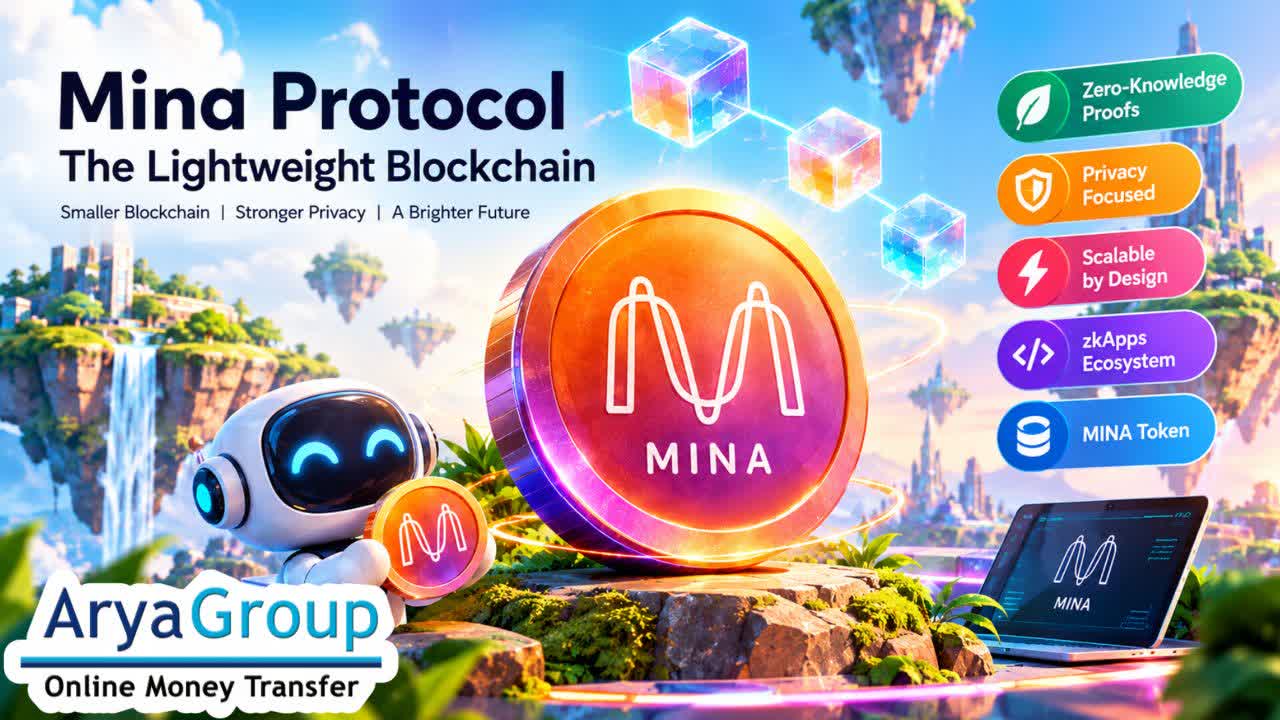
What Is Mina Protocol (MINA) in Cryptocurrency?
Understanding Mina Protocol
Mina Protocol is a Layer 1 blockchain designed to solve one of the major challenges facing traditional blockchain networks: increasing size and complexity.
As blockchains process more transactions, their historical records can become increasingly difficult to store and verify. Mina takes a different approach. Instead of requiring participants to download and process an ever-growing blockchain history, it uses advanced cryptography to maintain a compact representation of the network’s state.
Mina is often described as a lightweight or “succinct” blockchain because its protocol is designed to remain extremely small compared with many conventional blockchains. Its official documentation describes a blockchain of approximately 22 KB, although the amount of data required for practical network participation can vary.
The project aims to make blockchain verification more accessible while supporting privacy-focused applications and decentralized services.
How Does Mina Protocol Work?
Mina relies on zero-knowledge proofs, a cryptographic method that allows someone to demonstrate that a statement is true without revealing all the underlying information.
For example, a person could prove that they meet a particular requirement without disclosing every detail of their personal data. In blockchain technology, this approach can help verify computations and network activity more efficiently.
The Role of Recursive zk-SNARKs
One of Mina’s most important technologies is the recursive zk-SNARK.
A zk-SNARK is a type of zero-knowledge proof that can demonstrate the validity of information using a relatively small proof. Mina uses recursion to connect new proofs with earlier ones.
Rather than forcing every participant to independently examine the entire history of the blockchain, Mina allows the network to maintain a compact proof representing the validity of previous states.
This design helps keep the blockchain lightweight and makes it easier for users with ordinary computing devices to participate in verification.
Why a Small Blockchain Matters
A smaller blockchain can offer several potential benefits:
-
Easier verification: Users may be able to check network information without storing a massive historical database.
-
Greater accessibility: Participation may become more practical for people using less powerful devices.
-
Improved decentralization potential: More people may be able to operate network infrastructure.
-
Efficient use of resources: Compact proofs can reduce the amount of information that must be transmitted and processed.
However, a small blockchain does not automatically guarantee faster transactions, lower fees or complete decentralization. These outcomes also depend on the network’s design, activity and implementation.
What Are zkApps on Mina?
Mina supports zero-knowledge applications, commonly known as zkApps. These are decentralized applications that use zero-knowledge technology to verify computations while limiting the amount of information that must be revealed.
Developers can use Mina’s programming tools, including the o1js framework, to create applications that incorporate zero-knowledge proofs.
Potential Applications of zkApps
Mina’s technology could be useful in situations where users need to prove something without exposing sensitive personal information.
Possible examples include:
-
Digital identity: Demonstrating eligibility without revealing unnecessary personal details.
-
Financial services: Verifying certain financial conditions while protecting confidential information.
-
Private credentials: Confirming qualifications, memberships or other attributes.
-
Decentralized applications: Building services that combine verifiable computation with privacy features.
The exact capabilities of an application depend on its design and the features available on the Mina network.
What Is the MINA Token Used For?
MINA is the native cryptocurrency of Mina Protocol. It plays an important role in the operation and economic structure of the network.
Network Fees and Participation
MINA can be used to pay transaction fees and support activity on the blockchain. Like other blockchain networks, Mina needs an economic mechanism to process transactions and maintain network operations.
The token is also connected to the network’s consensus system, which uses a proof-of-stake model. Participants can contribute to network security through staking-related activities, subject to the protocol’s rules.
The market price of MINA, however, is determined by supply, demand, market sentiment and broader cryptocurrency conditions. The usefulness of a token does not guarantee that its price will rise.
Advantages and Challenges of Mina Protocol
Mina’s architecture gives it a distinctive position among blockchain projects, but it also comes with technical and practical challenges.
Main Advantages
-
Compact blockchain design: Mina aims to reduce the burden of storing and verifying blockchain history.
-
Zero-knowledge technology: Its cryptographic tools can support privacy-preserving applications.
-
Accessible verification: The lightweight design may make participation more practical for a wider range of users.
-
Programmable applications: Developers can build zkApps that use verifiable computations.
-
Decentralized infrastructure: The project’s design focuses on enabling broader participation in the network.
Important Limitations
Mina is not free from the difficulties faced by other blockchain platforms.
Zero-knowledge proof systems can require considerable computational resources to generate, even when the resulting proofs are small. Developing secure zkApps can also be technically demanding.
In addition, Mina competes with other Layer 1 networks and zero-knowledge projects. Its long-term success depends on developer adoption, network performance, security, user demand and the practical usefulness of its applications.
What Makes Mina Different From Other Blockchains?
Bitcoin and many other traditional blockchains rely on a growing record of historical transactions that network participants may need to store or verify. Mina’s main distinction is its use of recursive zero-knowledge proofs to maintain a compact representation of blockchain validity.
Ethereum, meanwhile, provides a broad platform for smart contracts and decentralized applications. Mina focuses more specifically on combining a lightweight blockchain structure with zero-knowledge programmability.
These networks are not necessarily direct substitutes. Each one has different technical goals, development tools and application ecosystems.
The Future of Mina Protocol
Mina’s long-term vision is connected to the wider development of zero-knowledge technology. As interest in blockchain privacy, scalable verification and decentralized identity grows, systems that can prove information without revealing unnecessary data may become increasingly useful.
The project’s future will depend on whether developers can create practical applications and whether users find those applications valuable.
Mina Protocol offers an interesting approach to blockchain design: instead of allowing the historical record to become the central burden, it uses cryptographic proofs to keep verification compact.
Final Thoughts
Mina Protocol (MINA) is a Layer 1 blockchain built around lightweight verification and zero-knowledge cryptography. Its use of recursive zk-SNARKs allows the network to maintain a compact representation of blockchain validity, while zkApps open the door to privacy-focused decentralized applications.
Although Mina faces competition and technical challenges, its approach addresses important questions about blockchain accessibility, privacy and scalability. For anyone exploring the future of zero-knowledge technology, Mina is a project worth understanding.

Add New Comment