


What Is Verkle Trees?
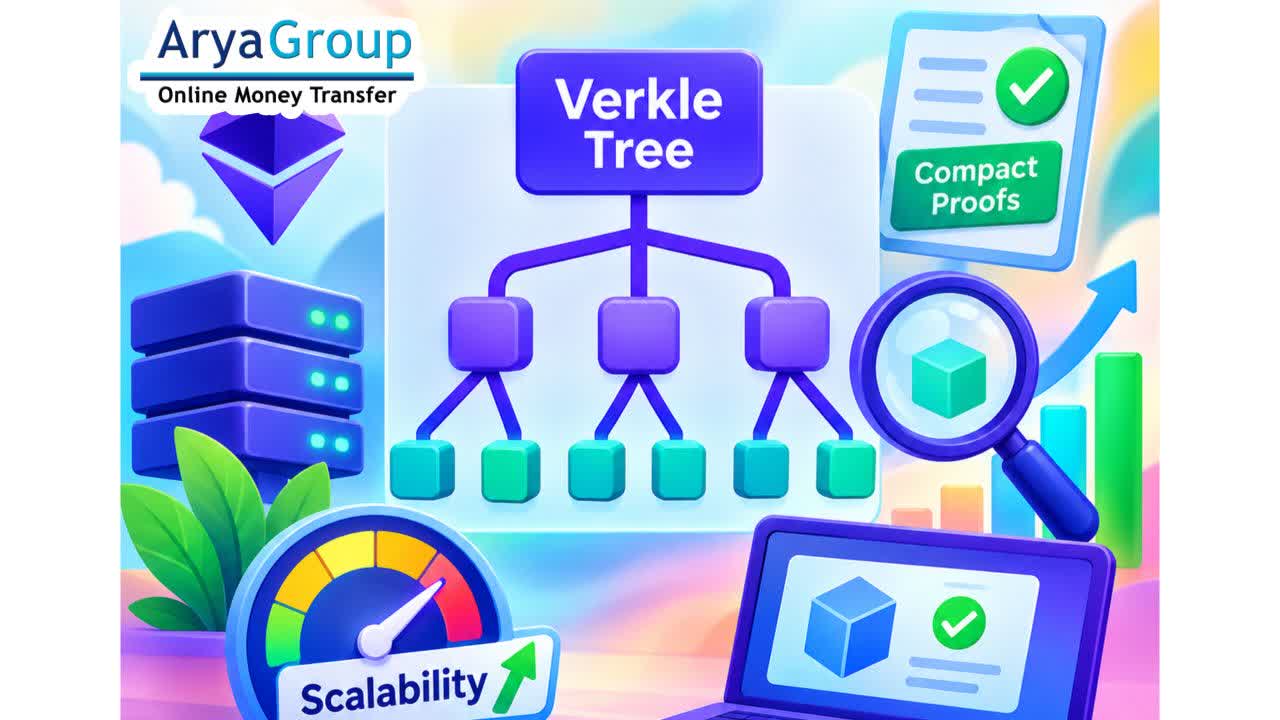
Verkle Trees: A New Way to Scale Blockchain Verification
What Is a Verkle Tree?
A Verkle Tree is a cryptographic data structure designed to make blockchain data easier and more efficient to verify. It is related to the better-known Merkle Tree, but it uses vector commitments to reduce the amount of information that users need to store or download when checking blockchain state.
In simple terms, a Verkle Tree helps a blockchain prove that a particular piece of information belongs to its current state without requiring the verifier to receive a large amount of additional data.
This is especially important as blockchain networks grow. As more transactions, smart contracts, and accounts are added, the amount of state that nodes must maintain can become increasingly difficult to manage.
How Does a Verkle Tree Work?
A Verkle Tree organizes blockchain information into a tree-like structure. Data is divided into smaller sections, and cryptographic commitments are used to represent those sections.
The major difference from a Merkle Tree is that a Verkle Tree can provide much smaller proofs. Instead of sending a long collection of hashes to demonstrate that data is part of a particular state, the network can use a compact cryptographic proof.
Verkle Proofs
A Verkle proof demonstrates that specific information exists at a particular location in the tree. Because the proof can remain relatively small even as the underlying data structure becomes larger, it can make blockchain verification more efficient.
Vector Commitments
Vector commitments are central to Verkle Trees. They allow a cryptographic commitment to represent many pieces of information while still making it possible to prove individual values efficiently.
This property is one of the reasons Verkle Trees are attractive for blockchain infrastructure.
Verkle Trees vs. Merkle Trees
Merkle Trees have been fundamental to blockchain technology for years. They allow participants to verify information without downloading every piece of data.
However, Merkle proofs can become relatively large when a tree contains a significant amount of information. Verkle Trees aim to solve this problem by using vector commitments.
|
Feature |
Merkle Tree |
Verkle Tree |
|
Main technology |
Hashes |
Vector commitments |
|
Proof size |
Can grow with tree structure |
Generally much smaller |
|
State verification |
Efficient |
More compact |
|
Scalability potential |
Good |
Higher for large state |
|
Main benefit |
Simple cryptographic verification |
Smaller proofs and efficient state access |
Why Are Verkle Trees Important for Ethereum?
One of the most important applications discussed for Verkle Trees is Ethereum. Ethereum nodes need to maintain and verify a growing amount of state, including account information and smart-contract data.
As the network expands, the cost of maintaining this state can become a challenge. Verkle Trees could help reduce the amount of information required to verify state.
Supporting Stateless Clients
A major concept associated with Verkle Trees is the idea of stateless clients.
A stateless client would not need to maintain the entire Ethereum state locally. Instead, it could receive the necessary information and a compact proof showing that the information is valid.
This could potentially lower hardware and storage requirements for some participants and make it easier for more users to verify blockchain activity.
Verkle Trees and Blockchain Scalability
Blockchain scalability is not only about processing more transactions per second. It is also about making sure that the network remains practical to operate and verify as its state grows.
Verkle Trees address this less-visible part of scalability.
Smaller proofs can reduce the amount of data that needs to be transmitted during verification. This can improve efficiency for nodes and potentially make decentralized participation easier.
Advantages of Verkle Trees
Smaller Proofs
The most important advantage is the ability to generate compact proofs for state information.
More Efficient State Verification
Nodes can verify specific information without processing as much supporting data.
Better Support for Stateless Designs
Compact proofs can make architectures involving stateless clients more practical.
Long-Term Scalability
As blockchain state continues to grow, more efficient cryptographic data structures could become increasingly valuable.
Challenges and Limitations
Verkle Trees are not a magic solution to every blockchain scalability problem. They introduce additional cryptographic complexity and require carefully designed implementations.
Changing an established blockchain's underlying data structure can also be technically difficult. Existing infrastructure, client software, and development tools may need substantial changes.
Furthermore, Verkle Trees primarily address state representation and verification. They do not automatically solve every problem related to transaction throughput, consensus, network bandwidth, or smart-contract execution.
The Future of Verkle Trees
Verkle Trees represent an important direction in blockchain infrastructure because they focus on a fundamental question: How can users verify an increasingly large blockchain without having to carry all of its data?
If successfully implemented, Verkle-based architectures could help blockchains reduce verification overhead and support more lightweight participants.
The broader significance of Verkle Trees is therefore not simply smaller proofs. Their real value lies in potentially helping blockchain networks remain verifiable, decentralized, and efficient as their state continues to expand.
Conclusion
A Verkle Tree is a cryptographic structure that combines tree-based organization with vector commitments to produce compact proofs. Compared with traditional Merkle Trees, it can significantly reduce proof sizes and improve the efficiency of state verification.
For blockchain networks such as Ethereum, this technology could play an important role in the long-term development of stateless clients and scalable infrastructure.
Add New Comment